
See the Difference
Aurora Ocular Grafts
Dehydrated amniotic membrane allografts with a 5 mm aperture — available in 12 mm and 10 mm diameters to support precise placement and superior healing.
5 mm opening preserves the visual axis throughout treatment.
Native growth factors and extracellular matrix components intact.
Room-temperature storage. No freezer required.
No surgical suite needed. Applied with a bandage contact lens.
Minimal-manipulation processing. FORMULA/5™ e-beam sterilization.
What is Aurora?
Aurora is a dehydrated amniotic membrane allograft engineered for office-based ocular surface treatment. It is processed using FORMULA/5™ e-beam sterilization and requires no refrigeration.
Its patent-pending 5 mm central aperture is Aurora's defining clinical feature — it leaves the visual axis unobstructed during treatment, eliminating the central visual blackout associated with first-generation amniotic membrane grafts.
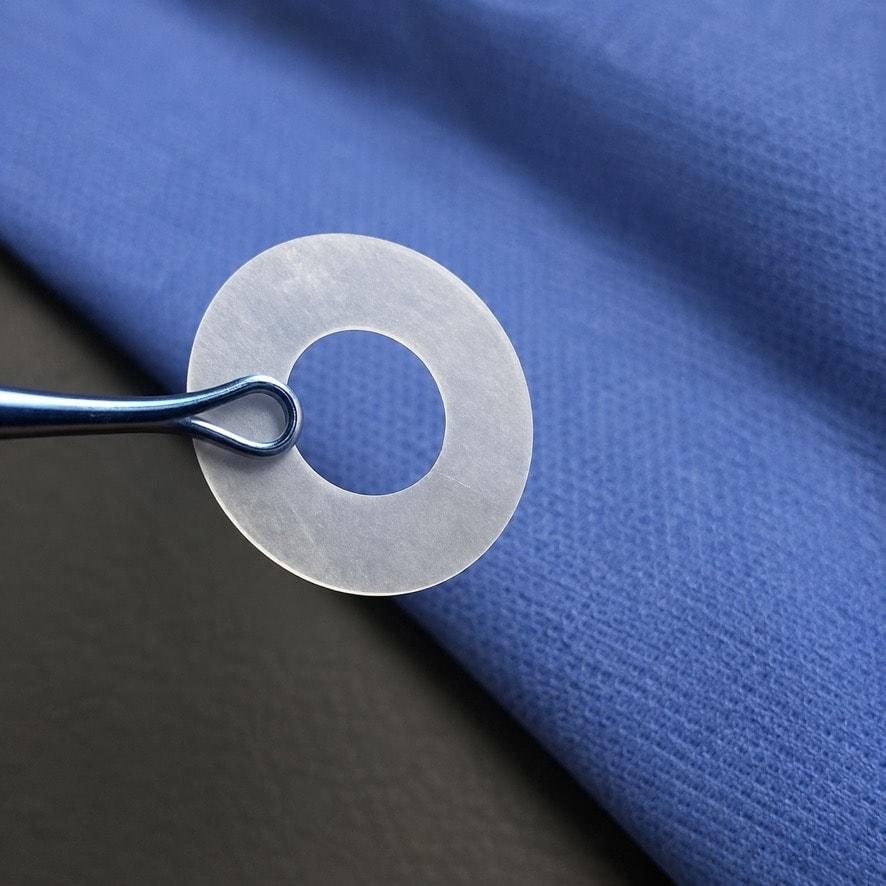
Two Sizes. One Aperture.
Both configurations share the same 5 mm central aperture and FORMULA/5™ processing. Choose the diameter that best fits your patient's anatomy.
Broader coverage for larger corneal surface area.
Compact profile for smaller or pediatric presentations.
Designed for Clinical Precision
Precision Placement
Disc geometry and aperture alignment support accurate, repeatable positioning on the ocular surface.
Controlled Coverage
Two diameter options let you match membrane size to the patient's corneal surface area.
Biologically Active
Preserves native growth factors, cytokines, and extracellular matrix components through FORMULA/5™ processing.
5-Year Shelf Life
Room-temperature storage. No freezer, no cold chain. Ready when you need it.
Minimal Manipulation
Processed under FDA HCT/P minimal-manipulation standards. No sutures required for office-based application.
FDA HCT/P Compliant
Regulated as a human cells, tissues, and cellular and tissue-based product under 21 CFR Part 1271.
What Sets Aurora Apart
First-generation amniotic membranes cover the entire cornea — including the visual axis. Aurora's aperture is the only design that eliminates central visual obstruction without sacrificing membrane coverage.
Opaque — full corneal coverage
Patent-pending aperture — visual axis preserved
Broad Indication Coverage
Aurora is indicated for a wide range of ocular surface conditions. ICD-10-CM codes are provided for documentation and billing reference.
Simple Ordering. Clear Reimbursement.
Average Medicare reimbursement. Verify with your MAC contractor before billing.
Aurora's Role in Modern Optometry
Dr. Alex Kabiri discusses Aurora's clinical impact and how it fits into today's optometry practice — live from Vision Expo West, Las Vegas.
Aurora in Practice
Application technique, clinical education, and live demonstrations from Dr. Kabiri and the Ophthalogix clinical team.
Revolutionizing Dry Eye Treatment: Eclipse & Aurora Solutions
Overview of the Ophthalogix product line — how Aurora and Eclipse address the full spectrum of ocular surface disease.
Aurora Amnion Membrane Application — Dr. Michael Johnson
Bandage lens combination application of Aurora Amnion Membrane Tissue with Dr. Michael Johnson.
Aurora Application — Dr. Alex Kabiri at AACO
Dr. Alex Kabiri applies the patent-pending Aurora amnion membrane tissue at the Ophthalogix booth at AACO in Austin, Texas.
Live Aurora Placement Demo — Dr. Michael Johnson at Indiana Optometry Convention
Dr. Michael Johnson demonstrates precise placement of the Aurora™ Amniotic Membrane during a live application.
Transforming Dry Eye Treatment — The Power of Aurora Amnion Tissue
Dr. Alex Kabiri on how Aurora's aperture design changes the patient experience and clinical outcomes in dry eye disease.
Treating Keratoconjunctivitis with Aurora Amnion Tissue
Dr. Alex Kabiri's expert insight on Aurora selection and application for keratoconjunctivitis.
Aurora — Official Product Video
Dr. Kabiri discusses Aurora's role in modern optometry practice from Vision Expo West, Las Vegas.
Dr. Alex Kabiri Guides SCO Students at AOA 2024 — Applying Aurora Amnion
Live teaching session with Southern College of Optometry students at AOA 2024 — Aurora application technique.
Common questions
Aurora — Frequently Asked Questions
Concise answers about this configuration. For the complete FAQ, visit the full FAQ page.
The aperture that eliminates visual blackout and protects central acuity.
The 5mm aperture is a precise physiological calculation, not just a comfort feature. By uncovering the visual axis, Aurora eliminates the central visual blackout associated with conventional membrane designs — allowing an immediate return to functional vision while concentrating native regulatory proteins directly over the peripheral epithelium and limbal zones where cellular signaling is most vital for surface reconstruction.
"The aperture is not a design detail — it is a clinical decision. Every element of Aurora was evaluated through the lens of what the patient experiences during treatment."
— Dr. Alexander Kabiri, O.D., Chief Medical Officer, Ophthalogix
FORMULA/5™ — Minimal-Manipulation Processing.
FORMULA/5™ is Ophthalogix's proprietary minimal-manipulation processing technique. It is designed to preserve the natural regulatory proteins and growth factors of the amniotic membrane without the use of harsh chemicals, solvents, or cross-linking agents. Processing is performed in compliance with FDA 21 CFR Part 1271 and AATB standards.
Technical specifications.
ICD-10-CM Reference
ICD-10-CM codes for documentation and billing. Laterality suffixes apply where noted (1 = right, 2 = left, 3 = bilateral, 9 = unspecified).
Right: H16.121 · Left: H16.122 · Bilateral: H16.123 · Unspecified: H16.129
Right, Left, Bilateral, Unspecified
Herpesviral keratitis
Laterality-specific
Other specified disorders of cornea
Depending on type / laterality
No unique ICD-10-CM code
Codes sourced from ICD-10-CM FY2026 (CMS). Verify laterality and specificity against current documentation before billing.
Ready to offer Aurora to your patients?
The only dehydrated amniotic membrane engineered to preserve the visual axis throughout treatment.