
Office-Based AMT Procedures
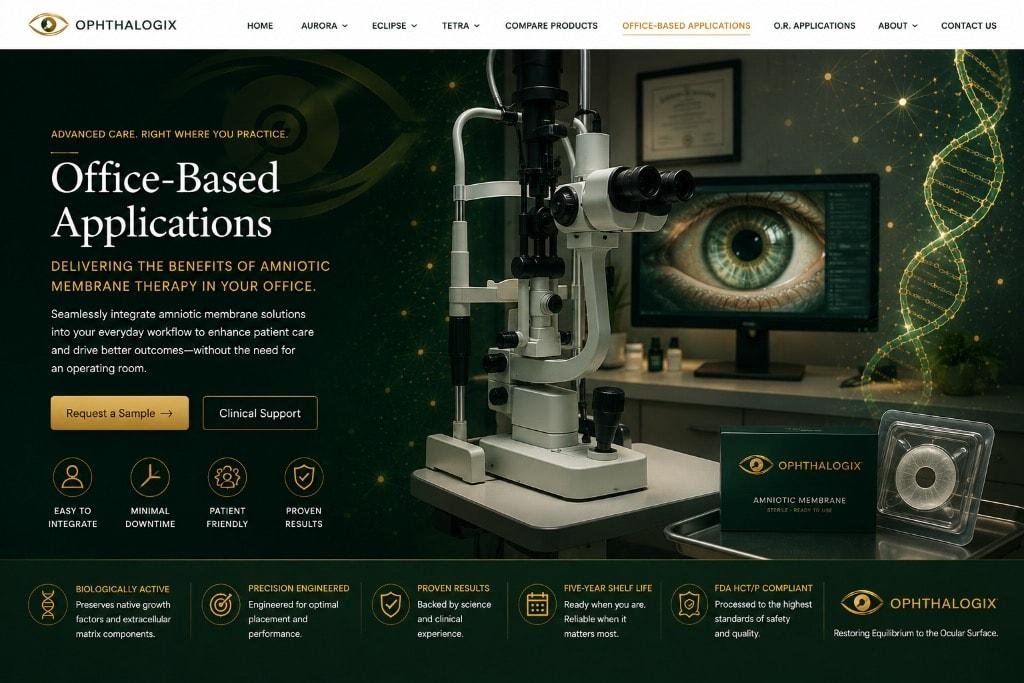
Office-Based
Applications
Seamlessly integrate amniotic membrane therapy into your everyday workflow — no operating room required.
Aurora
Dehydrated AMT with a central aperture for continuous visual function. Applied directly to the ocular surface in the exam lane. Worn for 5–7 days.
View product →Eclipse
Dehydrated AMT. Applied over corneal or conjunctival defects with a bandage contact lens. Dissolves in situ.
View product →Five steps. Ten minutes.
Patient preparation
Instill topical anesthetic. Assess defect size and select appropriate product and size. Confirm no contraindications.
Surface preparation
Irrigate the ocular surface. Debride loose epithelium if present. Dry the application site gently.
Tissue application
Remove tissue from packaging per IFU. Orient either side down. Center over defect or cornea. Smooth to remove air bubbles.
Secure and protect
For Eclipse: place bandage contact lens over tissue. For Aurora: confirm aperture alignment with visual axis. Instruct patient on wear.
Follow-up
Schedule follow-up at 5–7 days. Assess re-epithelialization. Document outcome and plan continuation of care.
When to use office-based AMT.
| Condition | Product | Notes |
|---|---|---|
| Dry eye disease | Aurora | Moderate-to-severe, inadequate response to drops |
| Recurrent corneal erosion | Eclipse | Acute episode or prophylactic after debridement |
| Neurotrophic keratitis | Aurora | Stage 2–3, concurrent with cenegermin if indicated |
| Persistent epithelial defect | Aurora / Eclipse | Post-surgical, post-infectious, or idiopathic |
| Chemical or thermal injury | Eclipse | Acute phase after irrigation and pH normalization |
| Corneal ulcer | Eclipse | Adjunct to antimicrobial therapy |
Ready to add office-based AMT to your practice?
The Ophthalogix clinical team can walk you through your first application, answer technique questions, and support your practice workflow.